
Fernando Botero - a painting from his Abu Ghraib series
From the CIA memo released on April 16, 2009.
These ten techniques are: (1) attention grasp, (2) walling, (3) facial hold, (4) facial slap (insult slap), (5) cramped confinement, (6) wall standing, (7) stress positions, (8) sleep deprivation, (9) insects placed in a confined box, and (10) the waterboard.
Disgraceful!!!
Showing posts with label Wars. Show all posts
Showing posts with label Wars. Show all posts
Apr 21, 2009
CIA's tortue techniques


Dec 20, 2008
Afghanistan
The Nation features an excellent article on Afghanistan by Robert Dreyfuss, who covers national security for Rolling Stone.
I'm going to incorporate it into the long post on Afghanistan (prior).
Ah, we are in the graveyard of empires now.

Dec 15, 2008
Hard Lessons: The Iraq Reconstruction Experience
On Saturday, the Times reported on
An unpublished 513-page federal history of the American-led reconstruction of Iraq depicts an effort crippled before the invasion by Pentagon planners who were hostile to the idea of rebuilding a foreign country, and then molded into a $100 billion failure by bureaucratic turf wars, spiraling violence and ignorance of the basic elements of Iraqi society and infrastructure.
...
In one passage, for example, former Secretary of State Colin L. Powell is quoted as saying that in the months after the 2003 invasion, the Defense Department “kept inventing numbers of Iraqi security forces — the number would jump 20,000 a week! ‘We now have 80,000, we now have 100,000, we now have 120,000.’ ”
Dec 11, 2008
Lashkar-e-Taiba
"The operation was so skillful and deadly, complete with a maritime landing by inflatable craft, that one security expert said that Navy SEALs would have had a hard time pulling it off."

A soldier in Mumbai during the siege of the Taj Mahal hotel.
The attackers studied satellite images of the city on Google Earth.
Photo from the New York Times
In the New Yorker, George Packer comments on the seeming hopelessness of reigning in terrorism, particularly that originating in Pakistan.
The attacks in Mumbai reveal the vexing complexity of the interconnected conflicts throughout south Asia. At the urging of the United States, Pakistan had moved six divisions from its eastern frontier with Indian Kashmir to fight militants on its western border with Afghanistan; now the terrorists have succeeded in inducing Pakistan to threaten to cut back its pressure on the tribal areas and redeploy its troops to the east. Islamist radicalism is the main spark that keeps inflaming these conflicts.
Some commentators have simply demanded that Pakistan rid itself of the virus of extremism that threatens its own security as well as its neighbors’. But which Pakistan is going to do it? The weak civilian government of President Asif Zardari? The two-faced security services? The tribal leaders along the Afghanistan border? The huge, overwhelmingly poor, tumultuous population? The core problem is that Pakistan is no longer really a country, if it ever was.
... The answers for Pakistan lie largely in its own hands—that’s the most frightening thing of all.
The terrorists used sophisticated technologies, including Voice over Internet Protocol (VoIP) services (for conference calls!) and precise geopositioning devices.
Nov 19, 2008
Afghanistan
If the economy is at the forefront of everyone's mind, we do have two wars going on. I. has some ideas about Iraq: he favors the partition. I don't know enough to have an opinion, but I do want us to stop bothering those poor people and to plan for some reparations as well.
Afghanistan
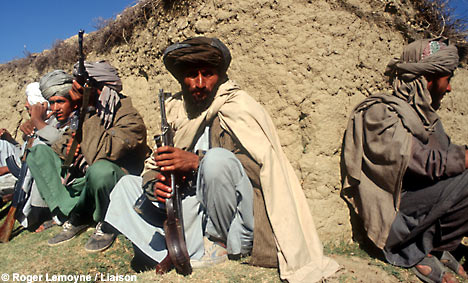
The Taliban, armed and defending their home to the death
Photo from the Daily Mail
It seems we have been trying to impose a nation-state on a bunch of tribespeople. Hamid Karzai is not much more than the mayor of Kabul. We have 30,000 troops over there. Why? The Soviets failed with hundreds of thousands of troops. OK, so we (and Saudi Arabia) were aiding the mujahideen with buckets of money, materiel and training, but still... wouldn't anyone fight an invader to the death? They might have beat the Soviets eventually, even without our and Saudi aid.
"When you're bleeding to death on the Afghan plains,
And the Afghan women come to cut up your remains,
Just roll on your rifle and blow out your brains,
And go to your Gawd like a soldier."
— Rudyard Kipling
So I've been thinking about this. My feeling is that Realpolitik will win out and we will have to opt for an ugly solution. Now here is a very interesting, very thorny, very explosive, and very long-term problem.
Defining the Problem
First, per a friend's suggestion (thank you, R.!), I present a recent episode of Frontline with some of my own commentary.

Let's begin with Frontline.
Along the Korengal Valley
 Photo from the New York Times
[Much, much more to come...]
A Surge?
In Small Wars Journal, a group of military strategists recommend a surge such as the one implemented in Iraq, with twenty troops per 1,000 inhabitants to provide security during an counter-insurgency operation. (I could not make out whether the 20:1000 ratio included troops for a counterinsurgency as well.)
This strategists would have us concentrate troops along the Afghan-Pakistan border — technically Pakistan's NW Frontier Provice that might as well be called Pashtunistan. A surge implemented solely in this region, with, per the white paper, its population of 42 million (14 million in Afghanistan, the remainder in the border region and in Pakistan proper) would require 840,000 troops. Well!
- The writers further recommend securing the border. Am I dense, or is securing a border a largely losing proposition? Let's ask Mr. Lou Dobbs, shall we?
- The writers also want to control the "road from Peshawar, Pakistan, through the Khyber Pass and onto Jalalabad ... a crucial lifeline for Afghans." Easier, perhaps, although much of this road is very rough terrain indeed.
- The white paper notes the Taliban's control in rural Pashtun "districts," although what the term means is unclear (at least to me).
"The Taliban understand the importance of coercing or influencing the Pashtun population in the rural districts and focus most of their attention on these areas. In July 2008, the Taliban operated in 130 Pashtun districts and from June to August 2008 temporarily overran 41 districts."Finally, the paper notes that "Afghan coalescing identity is tied to the district level with bottom-up governance" and is passingly pessimistic about the ability of a national government to form, let alone function.
No Surge; Nation-building
In Foreign Affairs, Barnett R. Rubin and Ahmed Rashid disaagree with a surge
The crisis in Afghanistan and Pakistan is beyond the point where more troops will help. U.S. strategy must be to seek compromise with insurgents while addressing regional rivalries and insecurities.
Cross-border attacks into Pakistan may produce an "October surprise" or provide material for apologists hoping to salvage George W. Bush's legacy, but they will not provide security. Advancing reconstruction, development, good governance, and counternarcotics efforts and building effective police and justice systems in Afghanistan will require many years of relative peace and security.
MIT Study of Tribal Rivalries
[Much more to come]
In other words, they hate each other.
"Thirty years of conflict has fragmented the traditional tribal structure which inhibits the type of broad tribal reconciliation found in the Iraqi Awakening Councils."

This map is from the MIT Center for International Studies. The information there is astounding: a lot of reading, but worth it.
Jul 15, 2008
Kosovo
The Balkans mess of the 1990s is not over. Jeremy Harding reports, in the London Review of Books, that humanitarian intervention in Kosovo has yielded few positive results, and that poverty is endemic.
"No one would have imagined that a UN protectorate in Europe, stuffed with NGOs and awash with donor receipts, could perform so badly. Kosovo has low growth, no inflation, and few signs of an emerging economy. The roads are bad, the water supply is subject to cuts – the water is contaminated in any case..." writes Mr. Harding.

Map from Time.com's Balkan file
I have often thought about traveling through the Balkans every few years. What is keeping the region stable (or semi-stable?) now?
Subscribe to:
Posts (Atom)


